Targets and judging3 min read
Two coloured lights can appear after a fencing exchange without two points being awarded. The useful question is which weapon you are watching and what the referee has decided. Learn to separate electrical registration, a valid target and priority before trying to judge a fast exchange yourself.
Read the guide ↗
Points across rounds3 min read
The coloured circles in curling are not a target with a different point value on every ring. Scoring depends on which stones are closest to the centre at the end. Understanding that count makes last-stone decisions, blank ends and apparently cautious shots much easier to discuss.
Read the guide ↗
Rallies and territory3 min read
A rugby referee may recognize an infringement and still allow the non-offending team to continue. For a newcomer, that can look like an ignored offence or an unexpectedly late whistle. Following the advantage signal and the developing opportunity provides a much clearer way to watch the passage.
Read the guide ↗
Rallies and territory3 min read
A cricket display such as 86/3 after 12.4 overs contains three kinds of information, not a fraction and a decimal. Once you separate runs, wickets and valid deliveries, the score becomes much easier to follow. The match format then tells you what those numbers mean for the contest.
Read the guide ↗
Rallies and territory3 min read
Indoor volleyball players change places so quickly that a newcomer can mistake tactical movement for a new rotation. Start with the service and the score. Knowing when the receiving side earns the serve gives you a stable reference for following the next rally and the players’ changing roles.
Read the guide ↗
Rallies and territory3 min read
A table-tennis game can reach 10–10 and continue for several more rallies. The service pattern changes at that point, while the requirement to win by two keeps the finish uncertain. A small point-by-point record can make a close game understandable without distracting you from the exchanges.
Read the guide ↗
Rallies and territory3 min read
Indoor handball does not become easy to understand by counting passes in every possession. The passive-play warning identifies a particular situation within an attack. Learn to notice that signal, the attackers’ response and the eventual decision while keeping ordinary circulation of the ball in its proper context.
Read the guide ↗
Rallies and territory3 min read
A long shot that reaches the net is not enough information to establish a field-hockey goal. In outdoor eleven-a-side hockey, the attacker’s play inside the circle is central. Following the ball’s path through that area makes deflections, shots and apparently surprising non-goals easier to understand.
Read the guide ↗
Rallies and territory3 min read
Squash players share a court, so a rally sometimes stops because access to the ball or a safe swing is in question. A let and a stroke have different scoring consequences. Read the referee’s decision before interpreting the scoreboard, and avoid treating every interrupted rally as identical.
Read the guide ↗
Targets and judging3 min read
Standalone Lead climbing ranks progress up a route, so a climber who moves slowly can finish above someone who falls sooner at high speed. Hold numbers and the plus symbol describe that progress. Read them within the same route and round before comparing performances.
Read the guide ↗
Points across rounds3 min read
The rider who crosses the final finish line first does not automatically win the Omnium. The event carries earlier points into a final points race. Understanding that running total explains why a sprint, a gained lap or a rider finishing farther back can change the overall standings.
Read the guide ↗
Lanes and routes3 min read
A rowing programme can list singles, pairs, doubles, fours, quads and eights in a short sequence. The names describe different crews and oar arrangements. Identify the boat class first, then use the race’s distance markers and timing splits to understand how the contest develops.
Read the guide ↗
Lanes and routes3 min read
A fast slalom run can fall behind a slower clean run once gate penalties are included. The watercourse demands a sequence of correctly negotiated gates as well as speed. Follow the course order, gate direction and final adjusted result before deciding which athlete has moved into the lead.
Read the guide ↗
Lanes and routes3 min read
A triathlon result may list swim, bike and run times beside two small transition columns. Leaving those transitions out can make your reconstruction of the result wrong. Start by identifying whether a display shows one segment or cumulative elapsed time, then follow the race’s complete timing sequence.
Read the guide ↗
Targets and judging3 min read
An archer can win a recurve match without having the larger combined arrow total across every set. Compound matchplay uses a different scoring logic. Distinguishing arrow values from set points makes the live graphic clearer and explains why one poor set can have very different consequences.
Read the guide ↗
Targets and judging3 min read
A figure-skating result has several numbers that can look like competing versions of the same score. Technical elements, programme components and deductions perform different jobs. Read their column labels first, then use the official segment total to understand how the separate pieces fit together.
Read the guide ↗
Targets and judging3 min read
The longest-looking jump does not necessarily produce the largest score. A ski-jumping result combines distance with style and, where applied, wind and gate adjustments. Follow those components individually so that the line on the snow and the final points graphic do not seem to contradict one another.
Read the guide ↗
Points across rounds3 min read
Nordic Combined links ski jumping with cross-country skiing, but not every format links them in the same way. In an individual Gundersen competition, jumping deficits become delayed starts. Reading that conversion lets you understand how the first athlete over the skiing finish can decide the combined contest.
Read the guide ↗
Lanes and routes3 min read
Two long-track skaters can appear to race each other while the medal contest includes every other pair still to come. The classical-distance format ranks recorded times. Reading the pair, lane exchange and running classification separately prevents a visually convincing finish from being mistaken for the complete event result.
Read the guide ↗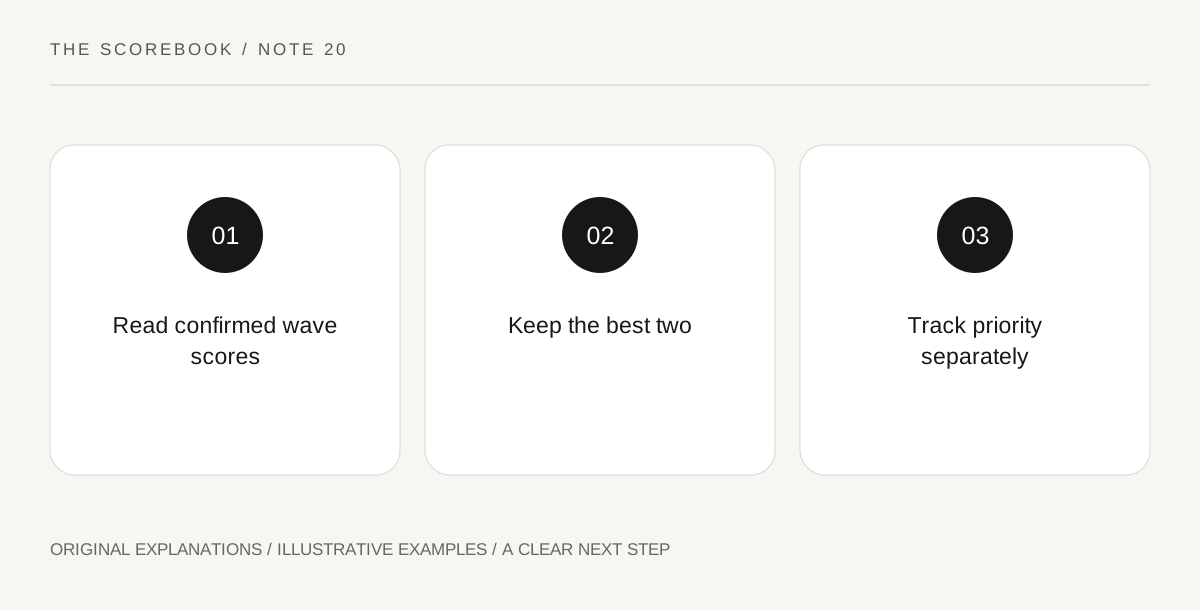
Targets and judging3 min read
A surfer can ride more waves than an opponent and still finish behind. In the familiar computer-scored ISA heat, the best two wave scores form the heat total. Understanding the lower counting wave, pending scores and priority makes the live graphic much more useful.
Read the guide ↗