Handball passive play: read the raised arm as part of an attack
Indoor handball does not become easy to understand by counting passes in every possession. The passive-play warning identifies a particular situation within an attack. Learn to notice that signal, the attackers’ response and the eventual decision while keeping ordinary circulation of the ball in its proper context.
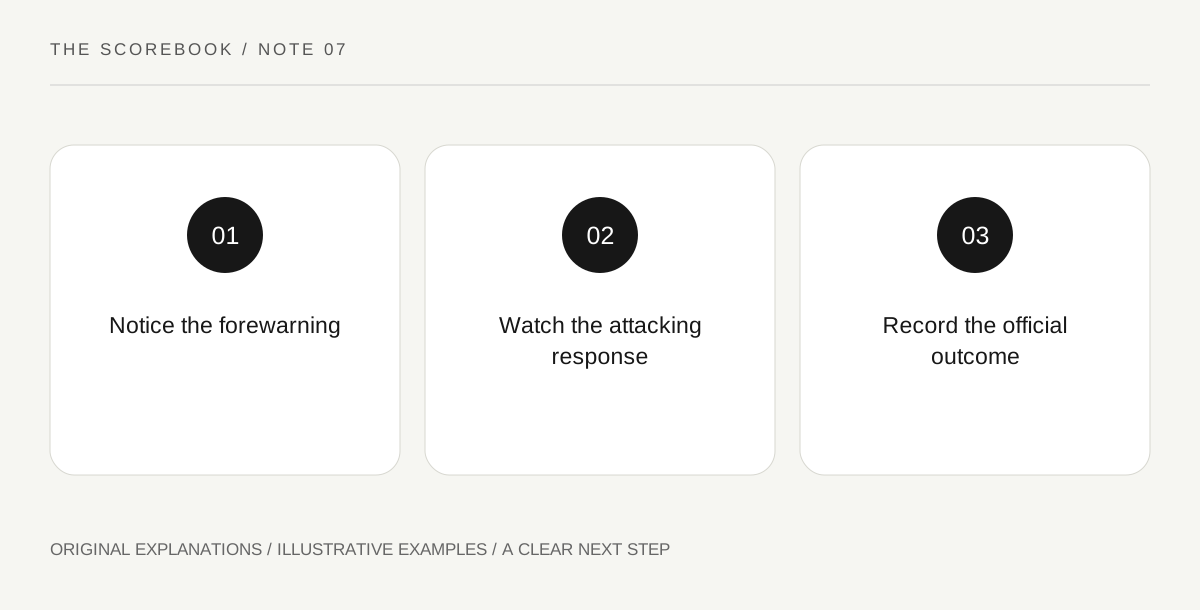
Original explanatory diagram. Read the full method and limitations below.
Identify the warning before counting
The IHF rules prohibit retaining possession without a recognizable attempt to attack or shoot. When the referees recognize a tendency toward passive play, they can show a forewarning signal. Under the current indoor provisions, the attack faces a limited passing opportunity after that warning, with specified exceptions and officiating judgments. It is not a universal four-pass limit beginning whenever a team gains the ball. Begin your spectator note at the warning, not at the first pass after a throw-off or a goalkeeper’s release.
Watch how the attack changes
After the signal, look for an attempt to create a shooting chance: a change of pace, a crossing movement, a pass toward the line player or a direct threat. Describe the movement you can see. A pass count alone cannot tell the full story of an attack interrupted by contact or a formal restart. Your viewing task is to connect the warning with the response, leaving technical exception decisions to the referees. That is a more faithful account than declaring a violation because your informal count differs from an announcement.
Distinguish the game clock from the warning
The main clock tells you the match time; a passive-play signal communicates the officials’ assessment of an attack. Do not invent a separate fixed countdown simply because other sports use a visible shot clock. In a note, put the approximate game minute beside the warning and record what follows in order. This lets you compare an attack in the middle of the first half with one late in a close game. The pressure of the scoreboard can be relevant without changing what you actually observed.
Use a short replay as a learning sample
Choose an available sequence that includes the signal rather than beginning only with the final whistle. Mark the warning, each clearly visible transfer and the shot or stoppage. If the replay cuts away, write “not shown” in that gap. Then compare your line with the official explanation or commentary. A television edit can omit a crucial restart, so an incomplete view should produce an incomplete conclusion. The exercise is about recognizing how an attack develops under a warning, not proving that an official missed a pass.
An illustrative two-column record
Imagine a team circulating the ball before the referee raises an arm. In the left column, write “warning shown”; in the right, describe the next visible attacking actions. A contact foul interrupts the sequence and the camera shows a coach. Leave that interval unresolved until you see the restart or hear its explanation. If the team later shoots, record that outcome. Do not splice the two camera segments into a confident uninterrupted count. Your note can still explain the change in urgency even when it cannot reconstruct every officiating detail.
Practical checks
Optional checkboxes save only in this browser.
Questions that come up
Are all handball possessions limited to four passes?
No. The passive-play provisions address a recognized situation, including the forewarning and its exceptions. They are not a simple restriction beginning with every new possession. Use the current indoor rulebook for exact application.
Is a slow-looking pass automatically passive play?
A spectator’s impression is not the complete test. Officials assess the attacking tendency and the circumstances. Describe whether the team creates or attempts a recognizable threat, and follow the actual signal and decision.
References and scope
These sources support the factual background. Examples and exercises are original illustrative teaching material. References do not imply endorsement.
- IHF Indoor Handball Rules, July 2025 — Passive-play warning, attack requirements and referee assessment.
- IHF regulations and documents — Current indoor handball rules and clarifications, distinct from beach and wheelchair rules.