Indoor volleyball: connect rally points with the service rotation
Indoor volleyball players change places so quickly that a newcomer can mistake tactical movement for a new rotation. Start with the service and the score. Knowing when the receiving side earns the serve gives you a stable reference for following the next rally and the players’ changing roles.
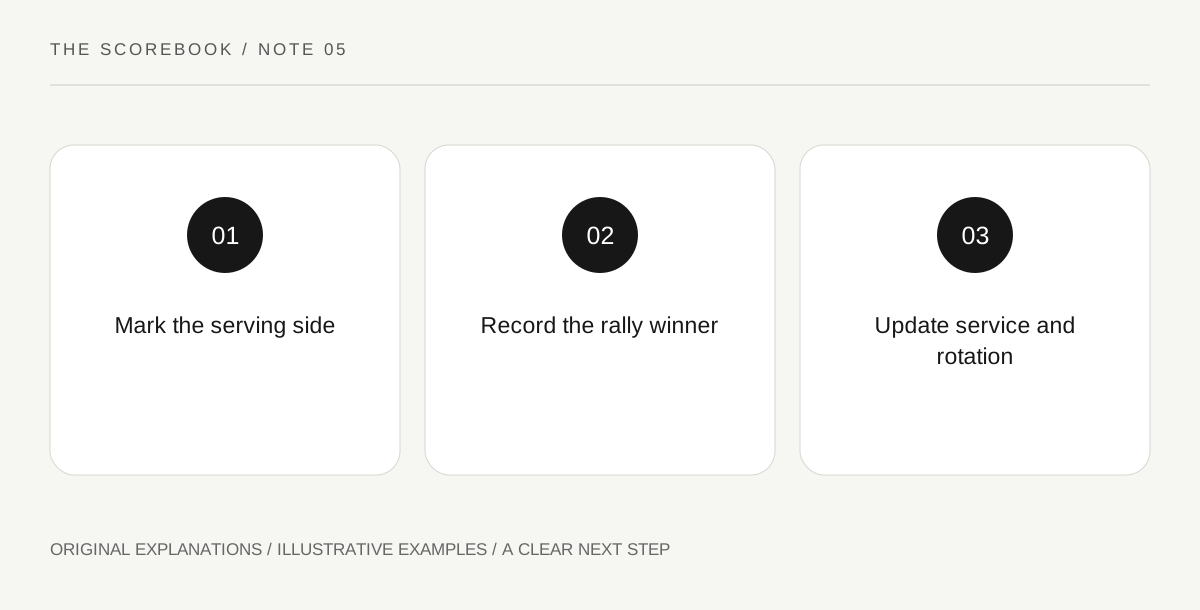
Original explanatory diagram. Read the full method and limitations below.
Follow a rally from serve to award
Under rally scoring, the team winning the rally earns a point. If the receiving team wins, it also gains service and rotates clockwise. A team that wins another rally while already serving does not rotate for that reason. Draw a small arrow beside the serving team’s score rather than trying to remember every player’s starting location. This makes the next server change a visible event in your note. Keep indoor six-player volleyball distinct from beach volleyball or local recreational variations when applying the explanation.
Separate rotational order from movement
A rotational position and the space a player occupies during an active rally are different ideas. Teams organize their reception and attack around specialist roles, so you will see players move after the serve. Sketch six numbered positions for one team, then place player initials on your sketch at a known restart. Follow one player for a few rallies. The sketch is a memory aid for the order; it should not imply that every player remains on the same painted square throughout the action. Detailed positional-fault judgments require the current rules.
Watch the first three contacts as a pattern
Instead of chasing every body movement, describe how a team turns a received ball into an attack: who handles the first contact, who organizes the next, and where the attack develops. The rules allow three team hits to return the ball, with block contact treated separately. The visible pattern may break down after a difficult reception. Record “recovery ball” or “attack from an awkward position” when that is what you see, rather than forcing every rally into a perfect pass-set-hit drawing. The contrast helps explain why some attacks are easier to anticipate.
Use the set score to frame the sequence
A run of points by one server can look decisive, but keep the set score and the match’s set count in different columns. A late rally changes the current set; it does not automatically settle the match. During an available replay, choose a short sequence that includes a receiving team winning service. Mark the awarded point, the clockwise rotation and the next server. If your labels no longer align, restart from the next clear lineup instead of guessing. A small accurate sequence teaches more than a whole set recorded with drifting names.
An invented four-rally sequence
Imagine A serves at 10–10 and wins the rally: the score becomes 11–10 and A serves again without a rotation triggered by that win. B wins the next rally, making 11–11; B gains service and rotates. B then wins one more rally while serving, reaching 12–11, and keeps that service. When A wins the fourth rally, A gains the point, the serve and its next rotation. Put a mark only at those two changes of service. The exercise distinguishes four awarded points from two rotation events.
Practical checks
Optional checkboxes save only in this browser.
Questions that come up
Does every point cause a rotation?
No. The relevant change occurs when the receiving team wins the rally and gains service. A team already serving can win consecutive rallies without rotating after each of those wins.
Why does a player move away from a numbered position?
Rotational order governs part of the team’s organization, while active play uses specialist attacking and defending roles. Observe the restart and the subsequent movement separately. Do not infer an illegal rotation just because the rally ends in a different formation.
References and scope
These sources support the factual background. Examples and exercises are original illustrative teaching material. References do not imply endorsement.
- FIVB: Basic rules — Rally scoring, service and receiving-team rotation in indoor volleyball.
- FIVB Official Volleyball Rules 2025–2028 — Set scoring, service order and front-row/back-row distinctions.