Table tennis: follow deuce without losing the server
A table-tennis game can reach 10–10 and continue for several more rallies. The service pattern changes at that point, while the requirement to win by two keeps the finish uncertain. A small point-by-point record can make a close game understandable without distracting you from the exchanges.
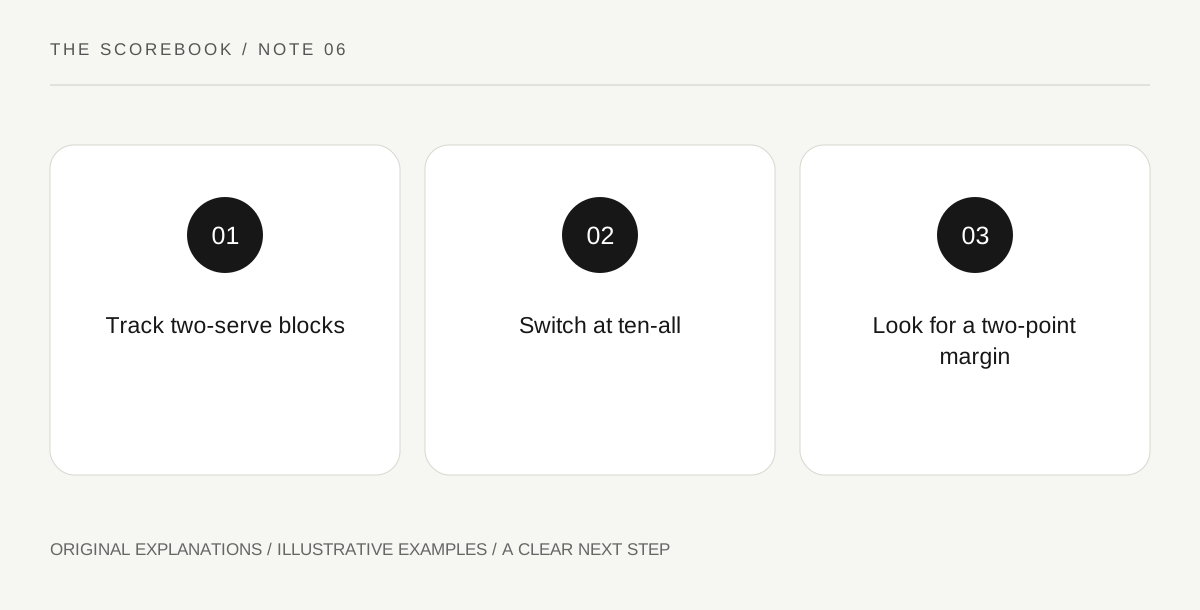
Original explanatory diagram. Read the full method and limitations below.
Name the scoring unit correctly
A point belongs to a rally, a game contains points, and a match contains games. Write the match’s game count apart from the current game score. Under the standard international system, games go to 11 with a two-point winning margin. Ten-all therefore does not produce a sudden-death point. A rally that creates 11–10 creates an advantage in the game; the trailing player can still bring it level again. Always distinguish this point score from a broadcast’s larger display showing games already won.
Keep an ordinary service tally
Before deuce, players normally alternate blocks of two serves. Start with the named first server and make a mark for each completed scored rally. A let that repeats the service does not award the point you are tracking. If you miss a rally, use the official score announcement to reconnect before extending the sequence. Guessing one missing point can put the next several service blocks on the wrong player. It is better to leave a small gap in a personal tally than to produce a complete-looking but false record.
Switch your notation at ten-all
From 10–10, service alternates after each point. Put one box beside each succeeding score and write the server’s initial above it. Follow the score as a pair, such as 11–10 and 11–11, rather than announcing “match point” from an isolated 11. Whether the situation can finish the match also depends on games already won. This method turns the closing sequence into a short alternating list. You can then concentrate on the difference between receiving and serving under pressure without memorizing a long chain.
Observe placement without inventing spin
For one close game, record whether the receiver plays short, opens strongly or sends the ball wide, using only what your view supports. A television angle may not reveal the exact serve spin, and a missed return is not proof of a particular technical error. Compare two consecutive service situations and describe the receiver’s response rather than diagnosing an unseen wrist action. Your point record supplies context: the same return attempt may occur at an ordinary mid-game score or at a one-point deficit near the finish.
An invented deuce finish
Suppose A serves the first point at 10–10 and B wins it, producing 10–11. B serves the next point and A wins, returning the game to 11–11. A then serves and wins for 12–11. B serves again and A wins for 13–11, which supplies the required two-point margin. Your note has four points and four alternating service assignments. It does not contain a game ending at 11–10 or 12–11. The invented sequence is a notation exercise, not a claim about a particular match.
Practical checks
Optional checkboxes save only in this browser.
Questions that come up
Does reaching eleven always finish the game?
No. A player needs a two-point margin. At 10–10, an 11–10 lead is insufficient; the opponent can still equalize. Continue reading both sides of the score rather than treating eleven as an automatic stopping signal.
Can I follow the game without identifying every spin?
Yes. Start with the server, score and visible placement. Exact spin judgments from a distant view can be unreliable. A clear account of the scoring sequence is already useful before you learn detailed technical analysis.
References and scope
These sources support the factual background. Examples and exercises are original illustrative teaching material. References do not imply endorsement.
- USA Table Tennis: Rules of table tennis — Introductory eleven-point scoring, alternating service and match terminology.
- ITTF current statutes and technical rules — Official rulebook access; check the edition and competition conditions for a specific event.