Rugby advantage: follow the opportunity before the whistle
A rugby referee may recognize an infringement and still allow the non-offending team to continue. For a newcomer, that can look like an ignored offence or an unexpectedly late whistle. Following the advantage signal and the developing opportunity provides a much clearer way to watch the passage.
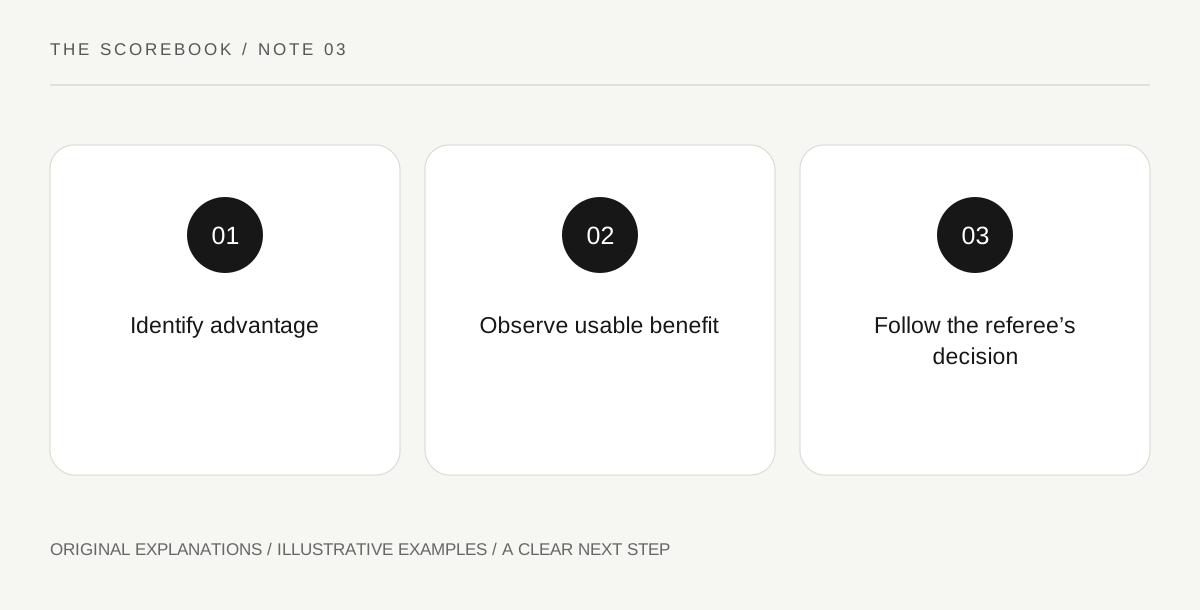
Original explanatory diagram. Read the full method and limitations below.
Understand what continues
Advantage allows the referee to keep play moving when stopping immediately could disadvantage the non-offending team. The referee assesses whether that team gains a meaningful tactical or territorial benefit. It is not simply a fixed number of seconds that a spectator can count down. Nor does continued play mean the original action was necessarily legal. Your first task is to identify which side has the advantage and what happens to its opportunity, rather than assuming that the absence of a whistle settles the infringement.
Track position and usable possession
On paper, mark where the advantage began and where the ball is when the referee next communicates a decision. Add whether the team can use the ball constructively. A large movement on the screen might include a camera pan, while a short gain with clear space may be more significant than it looks. Keep your description concrete: the team moved toward this touchline, passed to this receiver, or kicked into this space. These observations are more useful than saying it “looked promising” without identifying any change.
Distinguish a return from a new offence
A late whistle can take play back to the earlier infringement if the anticipated benefit does not develop. Note that return as one passage of play, with its original incident and later outcome linked. Do not automatically attribute the stoppage to the last tackle visible before the whistle. Conversely, another incident may occur during the passage. Listen to the referee’s explanation before deciding which infringement controls the restart. A spectator notebook should make uncertainty visible rather than assigning a confident reason to every pause.
Review the passage without hindsight
Pause an available replay just after advantage is indicated and describe the options visible at that moment. Continue until the next decision, then compare the outcome with your earlier description. This keeps a dropped ball later in the passage from erasing the opportunity that initially existed. It also stops a successful attack from proving that every earlier choice was inevitable. You are learning the sequence of an adjudicated opportunity, not rating the referee from a single dramatic ending. The governing laws remain the place to investigate a technical dispute.
An illustrative advantage log
Imagine blue receives advantage near midfield. Blue moves the ball twice and then loses control before finding useful space. Your entry could read: “advantage blue; two passes; ball lost; referee returns to the earlier incident.” If the referee instead announces advantage over before the loss, the note must reflect that different sequence. The two outcomes cannot be distinguished just by the final loose ball. Add the referee’s communication as a separate observation, and leave the exact restart description blank if you did not hear it clearly.
Practical checks
Optional checkboxes save only in this browser.
Questions that come up
Is every advantage the same duration?
No fixed spectator countdown replaces the referee’s assessment under the law. The circumstances and the kind of infringement matter. Watch for the referee’s communication rather than deciding that an arbitrary number of seconds must end the situation.
Why can play return to an earlier spot?
The continuing passage may not have produced the required benefit. Record the earlier incident and the return together. The place where the last pass failed does not necessarily identify the location of the infringement that controls the restart.
References and scope
These sources support the factual background. Examples and exercises are original illustrative teaching material. References do not imply endorsement.
- World Rugby: Advantage — Why a referee can allow play to continue after an infringement.
- World Rugby Laws: Law 7 Advantage — Tactical and territorial advantage and the referee’s assessment.