Read a cricket score: runs, wickets and overs are different numbers
A cricket display such as 86/3 after 12.4 overs contains three kinds of information, not a fraction and a decimal. Once you separate runs, wickets and valid deliveries, the score becomes much easier to follow. The match format then tells you what those numbers mean for the contest.
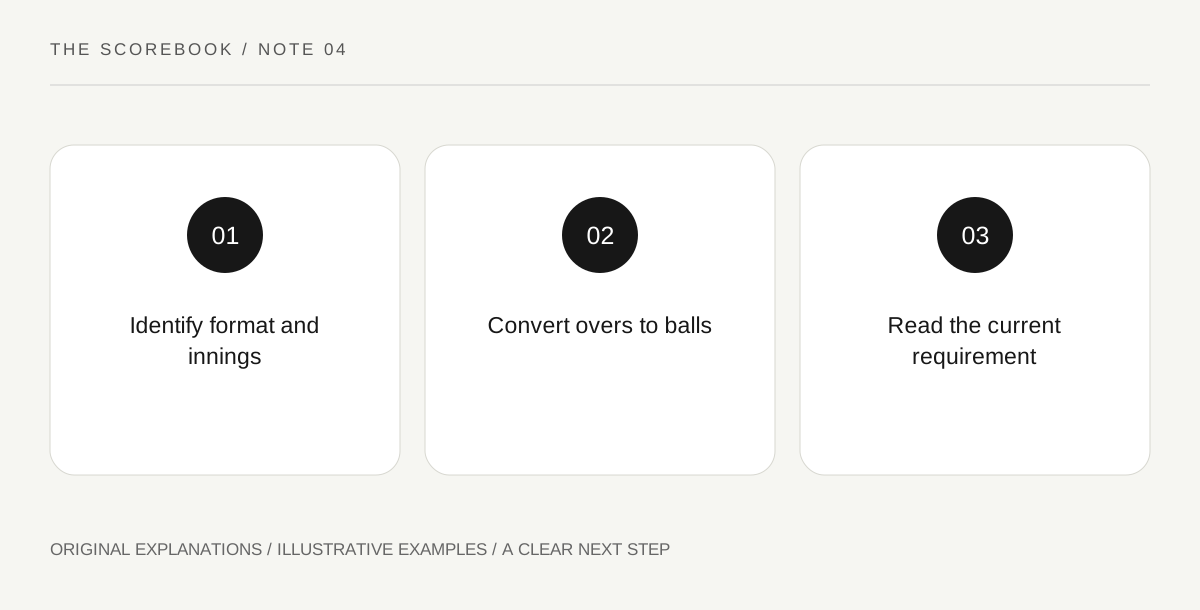
Original explanatory diagram. Read the full method and limitations below.
Read the format before the total
A Test match, a one-day international and a T20 international do not ask the batting side to solve the same timing problem. The ICC describes these as distinct formats with different innings structures and limits. Put the format and the current innings beside your score note. A total cannot be judged from its size alone: it matters whether the team is setting a total or pursuing a target, and how much of the allotted opportunity remains. Avoid comparing two broadcasts solely because both show a three-digit number.
Translate overs into deliveries
An over contains six valid balls under the Laws of Cricket. In the familiar score notation, 12.4 means twelve complete overs and four valid balls of the next, rather than 12.4 decimal overs. That is 76 valid deliveries. Wides and no-balls complicate the relationship between the number of physical deliveries and the valid-ball count. Use the official over display rather than counting every bowling action as one of the six. A small tally with six boxes per over makes the notation tangible when you are first learning.
Keep team runs and batter runs separate
A team score includes more than the runs shown beside a particular batter. Extras have their own scoring categories, so summing only the two batters currently at the crease will not reconstruct an innings. In your own note, copy the team total, wickets and over state first. Then add individual contributions only when you need to explain a particular passage. This order prevents a common confusion after a wicket, when a new batter appears with a small personal score while the team’s accumulated runs remain on the board.
Use arithmetic to describe a chase
For a simple uninterrupted illustrative chase, subtract the present team score from the stated target and convert the remaining overs to balls. Keep both units visible. Do not treat an adjusted target in an interrupted match as a number you can recreate with an informal proportional calculation. Use the officially announced target and conditions. Your arithmetic can explain the displayed requirement, but it does not predict the winner. A required rate is a current numerical description; wickets, opponents and conditions still shape what happens next.
An invented T20 chase
Suppose the announced target is 151 and the chasing team is 96/3 after 12.4 overs in an uninterrupted 20-over innings. It needs 55 more runs. Twelve complete overs plus four balls means 76 valid deliveries used, leaving 44 of the 120. The required rate is 55 divided by 44 times 6, or 7.5 runs per over. This example is arithmetic for that stated situation, not a forecast or a method for changing a rain-adjusted target. Write the 55 runs and 44 balls together so neither part of the requirement disappears.
Practical checks
Optional checkboxes save only in this browser.
Questions that come up
Is 12.5 nearly thirteen decimal overs?
No. It is twelve completed overs and five valid deliveries, or 77 valid balls. The next valid delivery completes the thirteenth over. Treat the separator as a notation convention rather than a decimal point.
Can a team’s total exceed the batters’ summed runs?
Yes. Extras contribute to the team score. Use the scorecard’s separate categories when reconciling the total, and distinguish all innings contributions from only the batters currently shown on screen.
References and scope
These sources support the factual background. Examples and exercises are original illustrative teaching material. References do not imply endorsement.
- ICC: Formats of the game — Distinction between Test, ODI and T20 international formats.
- MCC Laws of Cricket, 2026edition — Runs, wickets, innings and six valid deliveries in an over.