Track cycling Omnium: the last race changes an accumulated score
The rider who crosses the final finish line first does not automatically win the Omnium. The event carries earlier points into a final points race. Understanding that running total explains why a sprint, a gained lap or a rider finishing farther back can change the overall standings.
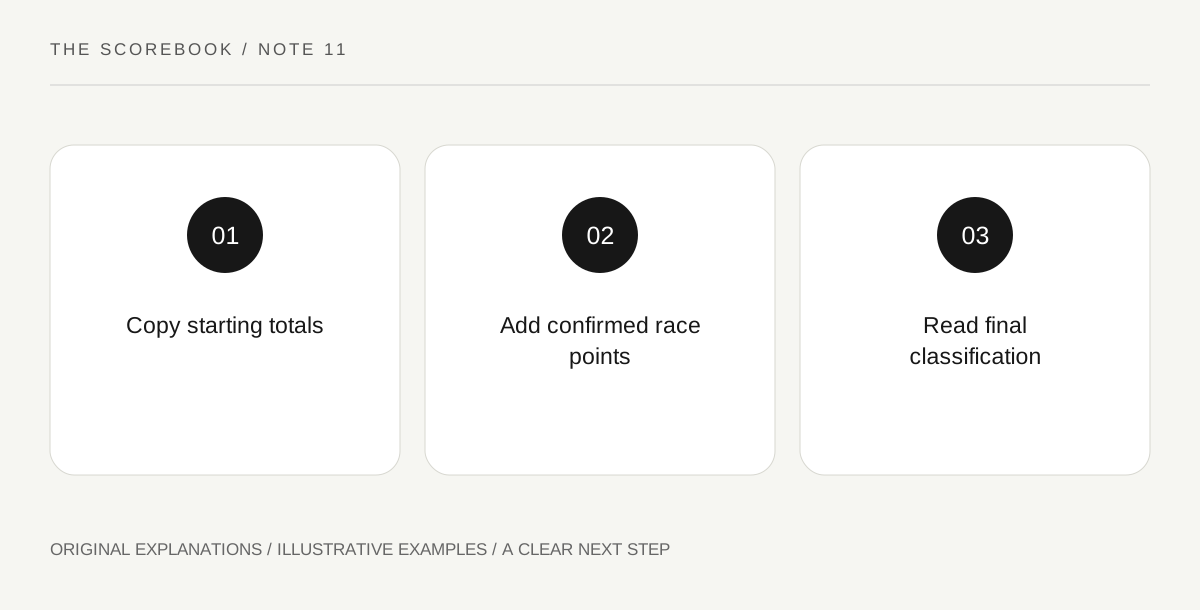
Original explanatory diagram. Read the full method and limitations below.
Identify the four-part contest
The Omnium combines scratch, tempo, elimination and points races. The first three produce an intermediate classification; points earned in the final points race are added to that existing total. This differs from treating each race as a separate medal or resetting everyone to zero for the last start. Copy the standings immediately before the points race. Those starting totals are the opening balance for everything you record afterward. Keep this Omnium explanation distinct from a standalone points race, the Madison or a sprint tournament.
Maintain a small running ledger
Choose two riders rather than trying to score the whole field on your first viewing. Write their existing totals in adjacent columns and add each official points award you can confirm. The final race includes scoring sprints and lap-related points, so a rider’s current physical position alone does not reconstruct the ledger. When the broadcast posts an updated classification, reconcile your two columns to it. If you missed an award, mark the gap instead of inventing a balancing number that merely makes the arithmetic look complete.
Separate the bunch picture from the classification
A camera may show a breakaway ahead of the bunch, then cut to riders who have changed position relative to the main field. Identify whom the graphic describes before assuming that the nearest rider to the finish is leading overall. A confirmed gained lap is a scoring event; it is not just a visually large gap. Look for the official indication and updated total. Your viewing note can distinguish “rider attacks,” “lap gain confirmed” and “classification updated” as three stages in the story.
Read the finishing sprint in context
The final sprint has its own points importance, but the total already accumulated still matters. Before the last laps, compare the gap between your two tracked riders with the points still available in the situation. This is a way to understand the displayed standings, not a betting calculation or a guarantee about tactics. Other riders and lap events can affect the outcome. At the finish, copy the official final classification rather than declaring the first visible finisher the overall winner from the camera image alone.
An invented two-rider ledger
Suppose A starts the points race with 110 and B with 104. In a simplified illustrative sequence, B receives a confirmed 20-point lap gain, making 124, while A’s total remains 110. A later earns 5 sprint points and reaches 115. B can therefore remain above A in this partial ledger even when A wins that particular sprint. Other race events are deliberately omitted from the example; a real final result requires the complete official classification. The exercise teaches why physical order at one finish line and accumulated Omnium order are different quantities.
Practical checks
Optional checkboxes save only in this browser.
Questions that come up
Does the last race begin with zero points?
No. The Omnium carries an intermediate classification from the earlier races into the points race. Start your ledger from those totals, then apply the officially awarded changes that occur in the final event.
Can a rider behind on the track lead overall?
Yes, a running points total need not match physical order at that moment. Earlier results and points-race events both matter. Check the classification graphic and the rider identity before interpreting the camera view.
References and scope
These sources support the factual background. Examples and exercises are original illustrative teaching material. References do not imply endorsement.
- UCI: About track cycling — Omnium structure and the final points race; other track events use different formats.
- UCI Track Cycling Regulations, January 2026 — Omnium classification, points-race additions and competition procedures.