Curling: count the stones before interpreting the hammer
The coloured circles in curling are not a target with a different point value on every ring. Scoring depends on which stones are closest to the centre at the end. Understanding that count makes last-stone decisions, blank ends and apparently cautious shots much easier to discuss.
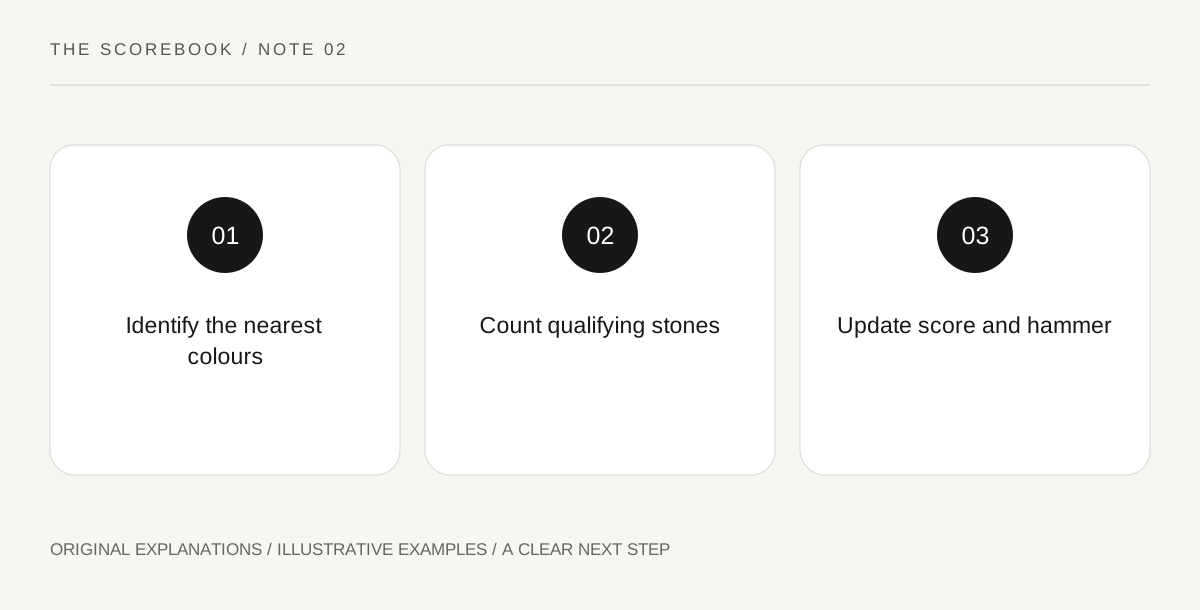
Original explanatory diagram. Read the full method and limitations below.
Count only after the end is complete
One team scores in an end: its eligible stones in or touching the house that are closer to the centre than the opponent’s nearest stone. The rings help you see distance, but their colours are not separate point bands. Begin by identifying the nearest stone of each colour. Then count only the scoring colour’s stones inside that comparison. A stone sitting dramatically near the outer edge might be irrelevant if the other colour already lies closer. A measuring decision belongs to the officials and players, not your camera-angle estimate.
Give the hammer its own column
The hammer is the last-stone advantage. In the usual four-player game, a scoring team gives up that advantage for the next end; a blank end ordinarily lets the same team keep it. Mixed doubles differs, including the hammer transfer after a blank. Put the format in your notes before borrowing a rule from another broadcast. A separate hammer column lets you distinguish “scored one” from “scored one and changed the last-stone situation,” which is the more useful description of the next end’s starting position.
Read a decision as a tradeoff
When a team removes a stone rather than trying a spectacular draw, ask what positions the shot leaves for the remaining deliveries. Sketch the stones with simple coloured circles and mark the stones still to come. You do not need to predict the perfect shot. Compare two possibilities: a crowded house with a chance for several points, or a clearer house with fewer immediate scoring opportunities. The point of the sketch is to connect the decision with the available stones, not to turn a spectator diagram into coaching advice.
Follow one end from setup to count
Choose a single end and resist switching attention to every other sheet. Record the score before play, who has the hammer, one important change in the house, and the eventual count. Then write one sentence about how the final stone changed the outcome. This gives you a small complete story. Over a whole match, an end-by-end line is more informative than a collection of impressive shots with no score attached. If the game ends by concession, preserve the completed ends rather than inventing a score for stones that were never played.
An invented house
Suppose red has stones at three different distances from the centre, while yellow’s nearest stone lies between red’s second and third. If the first two red stones qualify and no yellow stone is closer than them, red scores two. The farther red stone does not make it three merely because it is inside the rings. Write “red 2” in the end column. In a four-player game, update the hammer for the next end separately. That two-step record is clearer than assuming the ring colours supply the points.
Practical checks
Optional checkboxes save only in this browser.
Questions that come up
Is a stone on the outer ring worth one?
Its ring does not set its value. It can count as one scoring stone only if it qualifies relative to the opponent’s nearest stone when the end is scored. A close camera view can still be misleading.
Does a blank always keep the hammer?
Do not generalize across disciplines. The usual four-player treatment differs from mixed doubles. Use the event’s current rules and the announced hammer rather than carrying an assumption from another format.
References and scope
These sources support the factual background. Examples and exercises are original illustrative teaching material. References do not imply endorsement.
- World Curling: What is curling? — Scoring an end, last-stone advantage and the distinction between four-player and mixed doubles formats.
- World Curling rules — Current rulebooks and discipline-specific regulations.