Fencing lights: why the referee still decides the touch
Two coloured lights can appear after a fencing exchange without two points being awarded. The useful question is which weapon you are watching and what the referee has decided. Learn to separate electrical registration, a valid target and priority before trying to judge a fast exchange yourself.
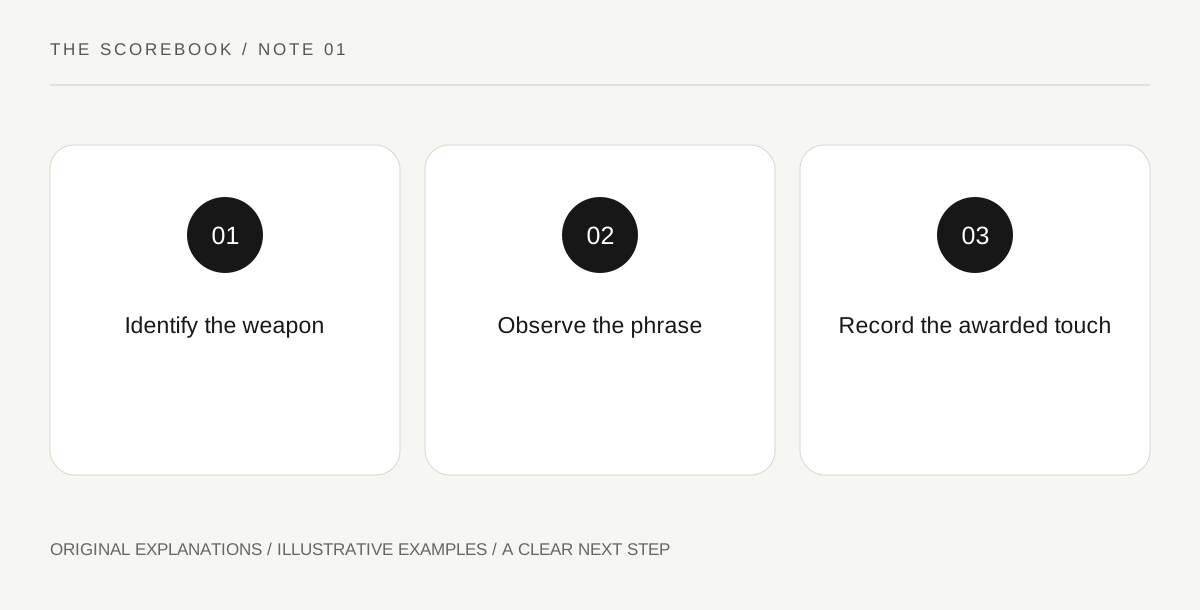
Original explanatory diagram. Read the full method and limitations below.
Start with the weapon label
Write foil, épée or sabre at the top of a viewing note. These are different contests with different valid targets and conventions. Foil and épée score with the point; sabre also permits cutting actions. Épée includes the whole body as a target, while foil and sabre have more restricted target areas. In foil and sabre, priority can decide a two-light exchange. A red lamp is therefore an input to a decision, rather than a universal instruction to add one point immediately.
Watch a phrase, then watch the decision
For your first replay, follow one fencer from the restart until the referee stops the action. Describe only visible events: advance, blade contact, extension, retreat, light. On a second viewing, listen to the referee and compare that description with the awarded touch. This exercise builds a sequence instead of relying on the final frozen frame. You can notice that a defender moved backward without claiming that backward movement alone settles priority. The actions before the lamps are the part a still photograph cannot explain.
Keep registration separate from the score
Make a three-column notebook: lamps, referee indication, scoreboard change. Leave the third column empty until the score actually updates. You might record two lamps and one awarded point, or an interrupted exchange without a score change. That simple separation prevents the common habit of counting every flash as a touch. If a review changes an initial award, draw one correction on your note rather than adding both decisions. The corrected score should reconcile with the number displayed at the next restart.
Use questions that a replay can answer
Ask which blade action occurred first, whether a parry is visible, and what the referee signalled. Avoid turning a difficult replay into a judgment about an athlete’s honesty. The television angle may hide a blade or compress the distance between the fencers. A useful spectator can say that the decision is unclear from this view. Save the weapon, approximate bout score and the particular exchange if you want to compare the explanation with the technical rules later; a general complaint about the lights is much harder to investigate.
An invented two-light note
Imagine a foil bout at 4–3. Both coloured lamps appear. Your first entry is simply “two lamps, decision pending.” The referee awards the touch to the fencer who had 3, and the board becomes 4–4. Your record now has one additional awarded touch, not two. On replay you can study the referee’s explanation of the phrase without changing the arithmetic. Had you written 5–4 on the lamps alone, your next observation would begin from an incorrect score and every later exchange would be harder to follow.
Practical checks
Optional checkboxes save only in this browser.
Questions that come up
Can I identify priority from who moved forward?
Forward movement can be part of what you observe, but it is not a complete substitute for the fencing conventions or the referee’s assessment. Include the blade action and timing, and allow for details the camera cannot show.
Should I count a reviewed touch twice?
No. Treat a changed award as a correction to the same exchange. Reconcile your note to the official board before the next restart so that your personal score does not drift.
References and scope
These sources support the factual background. Examples and exercises are original illustrative teaching material. References do not imply endorsement.
- FIE Technical Rules, August 2026 — Weapon targets, electronic registration and referee decisions on the fencing phrase.
- FIE Paris 2024 sport guide — An introductory illustration of the three weapons and competition structure; event-specific historical guide.