Lead climbing scores: a higher hold is different from a faster climb
Standalone Lead climbing ranks progress up a route, so a climber who moves slowly can finish above someone who falls sooner at high speed. Hold numbers and the plus symbol describe that progress. Read them within the same route and round before comparing performances.
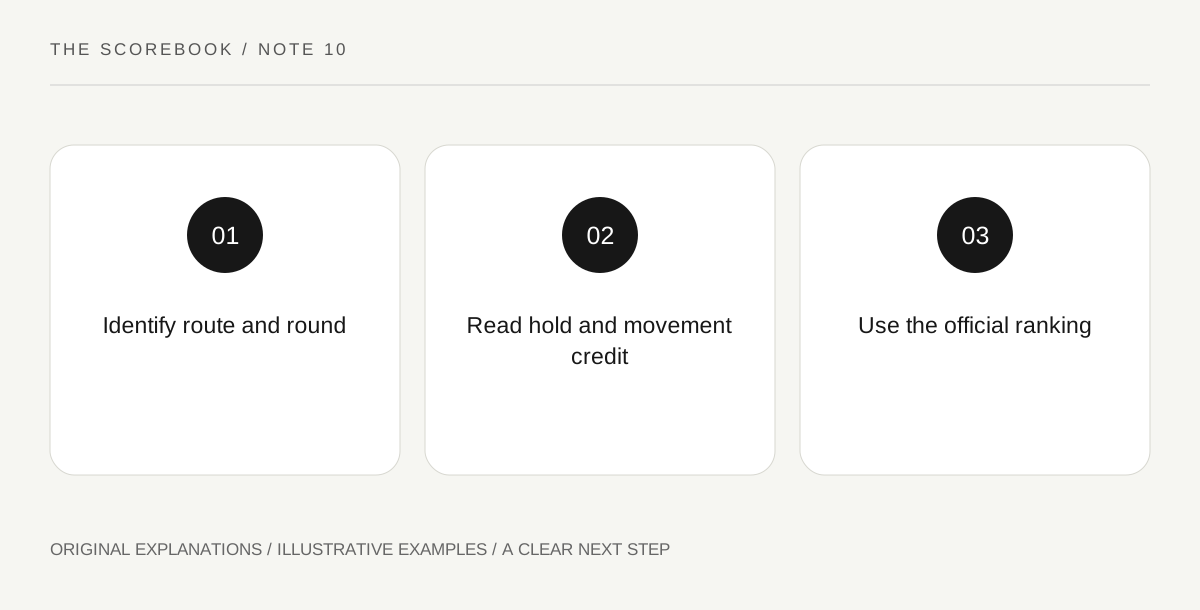
Original explanatory diagram. Read the full method and limitations below.
Locate the scoring route
Lead competitors climb a roped route one at a time. The result records progress through scoring holds, with a plus indicating qualifying movement toward the next hold beyond a controlled position. A top has its own completion requirements in the rules. The number is not the athlete’s height in metres, and a plus is not an extra whole hold. Keep standalone Lead separate from a combined-event points display. The score’s meaning depends on the competition format rather than on a familiar-looking number alone.
Watch control before the next move
Choose an available replay and identify a moment when the climber establishes a hand position before moving onward. Then follow the next attempted movement. Describe what is visible without assigning a hold number from the wall’s colour or from your own count of every plastic feature. Not every visible surface necessarily corresponds to your imagined scoring sequence. A route diagram or official result supplies the numbering context. Your observation can explain the difference between holding a position and moving onward even when the exact technical credit requires the officials’ view.
Compare within the same round
A hold number on one route is not a universal unit that lets you rank climbs on completely different routes. The wall can be reset between rounds, so attach qualification, semifinal or final to every result you copy. Compare the climbers who faced that particular route, then read the official ranking for any tie treatment. This avoids declaring an earlier-round number “better” than a later-round number without considering that they describe different sequences. The route is part of the measurement, not decorative background.
Use the clock without making it the score
The time limit shapes an attempt, but the fastest visible movement is not automatically the winning performance. Note where a climber rests, how much of the permitted time remains and where the attempt ends. For your own viewing exercise, choose one rest and ask which moves follow it, rather than assuming that any pause is wasted time. The useful description combines route progress and time context. Exact tie procedures belong to the event rules; do not replace them with an improvised fastest-climber rule.
An invented result line
Imagine the official result for one final lists A at 31+, B at 31 and C at 30+. Reading those entries as progress on that same route places A’s credited movement above B’s controlled hold 31, and both beyond C’s hold 30 with its plus. This illustration does not tell you that A climbed faster or that 31 on another wall represents the same difficulty. Copy the round and route alongside the three scores. Then use the replay to see the sequence that produced the displayed distinction rather than treating the symbols as a timing table.
Practical checks
Optional checkboxes save only in this browser.
Questions that come up
Is a plus equivalent to the next numbered hold?
No. It distinguishes qualifying movement beyond a controlled scoring position. It is not a complete additional hold. Use the actual official result rather than converting the symbol into a made-up decimal or height measurement.
Can I compare hold 32 in two different finals?
Not as an equal physical distance or equal difficulty. Different routes use different movement sequences. The score is meaningful within its scoring route and round; cross-event comparison needs much more context than the hold number.
References and scope
These sources support the factual background. Examples and exercises are original illustrative teaching material. References do not imply endorsement.
- World Climbing: Lead explained — Lead hold-height scoring and the plus notation; standalone Lead context.
- World Climbing 2026 Competition Rules — Controlled scoring holds, movement and competition-specific ranking provisions.