Canoe slalom: add the penalties before comparing the clock
A fast slalom run can fall behind a slower clean run once gate penalties are included. The watercourse demands a sequence of correctly negotiated gates as well as speed. Follow the course order, gate direction and final adjusted result before deciding which athlete has moved into the lead.
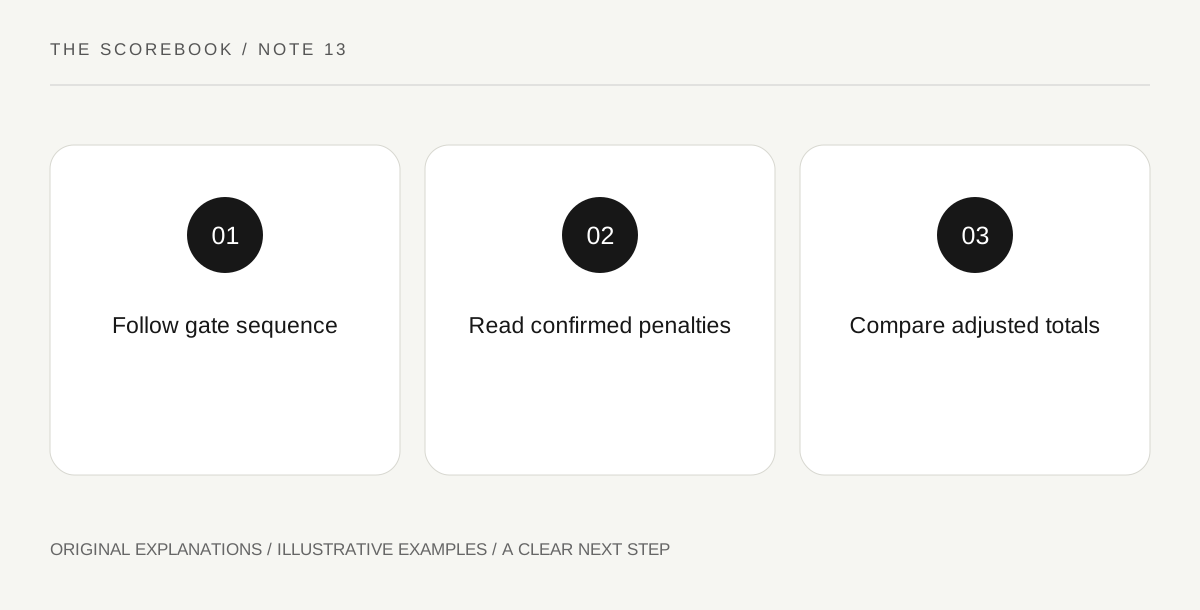
Original explanatory diagram. Read the full method and limitations below.
Read the gate direction
Canoe slalom uses green downstream gates and red upstream gates. The athlete must negotiate the course in its required sequence, so the shortest-looking route down the water is not necessarily the required route. Begin with a course diagram if the event provides one. Mark one upstream gate you can see clearly and follow how the paddler approaches and leaves it. This makes the route a sequence of tasks rather than a blur of hanging poles. Canoe and kayak are separate classes, even when they share a venue.
Separate elapsed time from added seconds
The ICF’s discipline explanation distinguishes a two-second penalty for touching a gate from a fifty-second penalty for failing to negotiate it correctly. The adjusted result therefore requires more than the raw elapsed clock. In a simple note, give raw time, penalties and adjusted total their own columns. Do not treat repeated camera angles of the same contact as separate penalties. Use the official gate record and any final corrections to determine the actual additions rather than building a score from how many collisions a television replay appears to show.
Observe passage as well as contact
A gate can raise a judging question even without a dramatic visible strike. Correct passage concerns the required gate line and direction, not only whether a pole swings. A downstream camera may hide the athlete’s head or the boat at the crucial moment. Describe what you can see and wait for the adjudicated gate result. A quiet-looking run is not proof that every gate was credited, while a pole already moving in the water is not by itself proof of an athlete’s touch. The complete sequence matters.
Compare athletes within the same competition stage
Write heat, semifinal or final with every run you record. The event rules determine how runs contribute to advancement, and those arrangements should not be inferred from an old highlight video. Compare adjusted results from the same stage and class. If a timing graphic temporarily updates before a penalty review is settled, label the position provisional. That small word prevents an initial “new leader” note from becoming a false final result. The official results list is the point at which your viewing arithmetic should reconcile.
An invented time comparison
Athlete A completes a run in 94.20 seconds with two separate confirmed two-second gate penalties. The adjusted total is 98.20. Athlete B records 96.10 with no penalties and therefore ranks ahead of A in this simple comparison, despite B’s slower raw run. If A instead had one fifty-second missed-gate penalty, the effect would be very different. The example assumes the same class and round and no other adjustments. Keep those assumptions beside the numbers rather than presenting them as an actual race result.
Practical checks
Optional checkboxes save only in this browser.
Questions that come up
Is touching the pole the only way to receive a penalty?
No. Failure to negotiate a gate correctly can carry a much larger penalty. The camera may not reveal every aspect of passage. Use the official gate decision rather than assuming that a run without obvious pole strikes is necessarily clean.
Why did the fastest clock not take the lead?
The displayed raw time may need penalty additions. Compare the adjusted totals and check whether any result remains provisional. A clean run can rank ahead of a faster elapsed run after those additions.
References and scope
These sources support the factual background. Examples and exercises are original illustrative teaching material. References do not imply endorsement.
- ICF: Canoe Slalom — Upstream/downstream gate colours, elapsed time and two- or fifty-second penalties.
- ICF: The all-seeing eye of the judge — Historical explanation of judging gate passage and the limits of a television angle; not current event advancement rules.