Triathlon splits: put T1 and T2 back into the race
A triathlon result may list swim, bike and run times beside two small transition columns. Leaving those transitions out can make your reconstruction of the result wrong. Start by identifying whether a display shows one segment or cumulative elapsed time, then follow the race’s complete timing sequence.
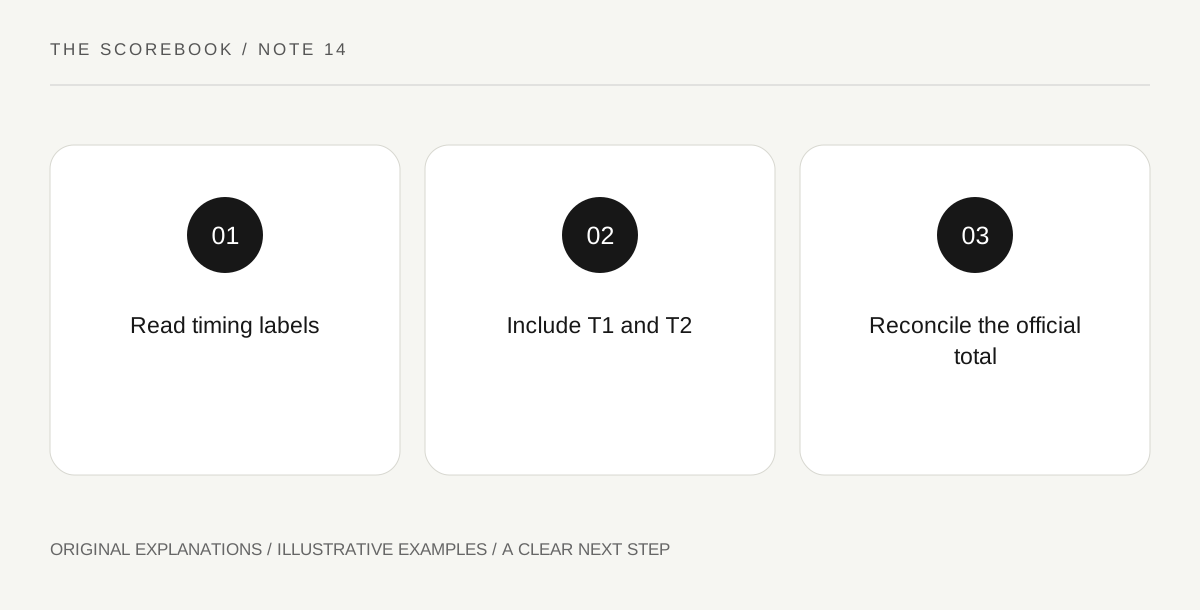
Original explanatory diagram. Read the full method and limitations below.
Name the two transitions
T1 is the change from swim to bike, and T2 is the change from bike to run. They are parts of the race, not breaks outside the clock. The transition area also has event rules and controlled access. For a spectator, the important first distinction is between the segment just completed and the total time since the athlete’s applicable start. Copy the timing column labels exactly before doing arithmetic. A number labelled “bike split” answers a different question from a cumulative time at the bike finish.
Build a complete timing line
Write swim, T1, bike, T2 and run in order, leaving a space for penalties or other officially applied adjustments. A total assembled from only the three sporting segments can omit meaningful time. Use consistent units: converting each entry to seconds before summing avoids treating 1:45 as 1.45 minutes. After adding, convert the total back to hours, minutes and seconds. This is a way to understand the published result, not a substitute for the official timing system or a method for resolving every competition-specific adjustment.
Check whose clock you are watching
Mass starts, waves and other start arrangements can make the physical order seen at a location different from the relevant timed order. Read the event format and the timing graphic rather than assuming that two athletes passing the same camera began together. If you cannot establish a shared start, describe the visible order without calling it the overall lead. Your note becomes more accurate by attaching a start group and athlete identity to the split. Those details are particularly useful when a broadcast switches between different categories.
Watch transitions as a sequence of tasks
For one athlete, follow arrival, movement through the transition area and departure using an available replay. Notice where the timing mat sits if the course information shows it. A long transition split can include travel through the area as well as equipment changes, so avoid attributing the entire number to one dropped item or a slow shoe change. Keep course layout and visible actions separate. The exercise teaches why a small column in a results table can represent a substantial part of the contest’s movement and organization.
An invented full-race sum
Suppose a result lists swim 18:20, T1 at 1:05, bike 58:40, T2 at 0:45 and run 36:10, with no additional adjustment in this simplified example. The three sport segments sum to 1:53:10. Adding both transitions gives 1:55:00. A comparison that omitted them would understate the elapsed result by 1:50. Write the complete five-part line before comparing with another athlete. The invented numbers do not imply any specific race distance, field standard or personal training target.
Practical checks
Optional checkboxes save only in this browser.
Questions that come up
Are transition times included in the race?
Yes. They form part of the timed sequence. The event’s timing definitions and official adjustments govern the final result. Do not remove T1 and T2 simply because they are not swimming, cycling or running splits.
Does a long T1 prove a slow equipment change?
No. The split can include the route through the transition area and its timing boundaries. Compare the course layout and the visible sequence before attributing the whole number to one action.
References and scope
These sources support the factual background. Examples and exercises are original illustrative teaching material. References do not imply endorsement.
- World Triathlon: Talk like a triathlete — Split time, T1, T2, waves and race-format vocabulary.
- World Triathlon FAQs — Event-specific athlete guides, transition access and competition-rule context.