Long-track speed skating: a pair is part of a larger time trial
Two long-track skaters can appear to race each other while the medal contest includes every other pair still to come. The classical-distance format ranks recorded times. Reading the pair, lane exchange and running classification separately prevents a visually convincing finish from being mistaken for the complete event result.
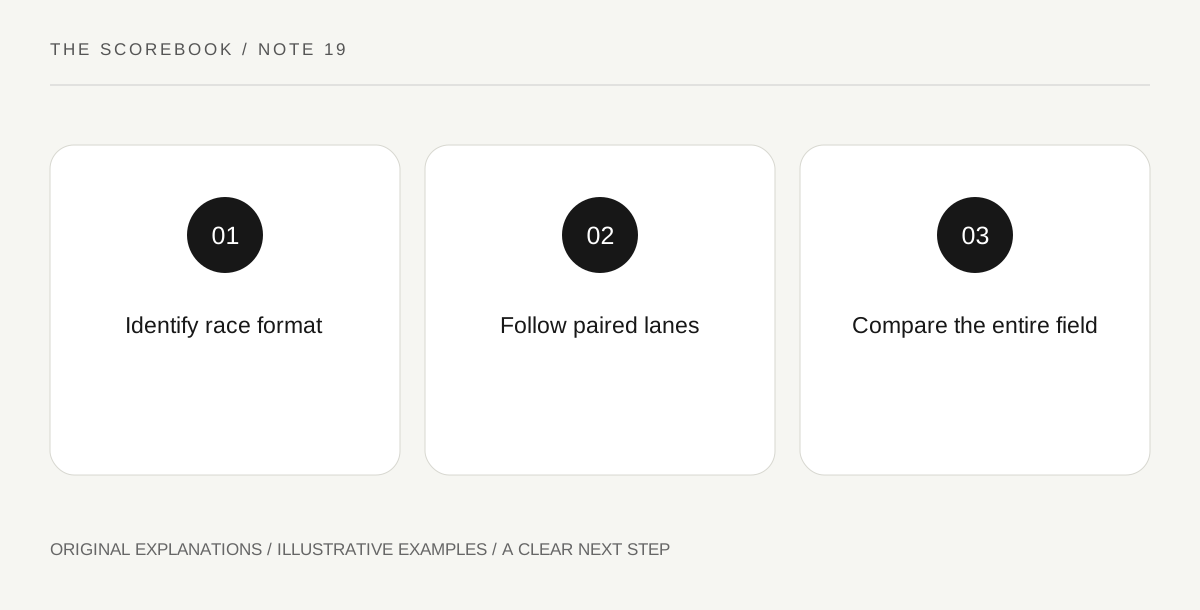
Original explanatory diagram. Read the full method and limitations below.
Identify a classical paired event
ISU’s classical-distance explanation describes skaters competing in pairs, with the fastest recorded time across all pairs winning. Other long-track formats, including mass start and team events, use different structures. Put the race type and distance at the top of your note. Winning a particular pair is a useful observation, but the ranking still depends on the times already recorded and the athletes yet to race. A large gap to the other skater in one pair does not by itself measure the gap to the entire field.
Follow the exchange on the backstretch
In paired classical races, skaters change between inner and outer lanes on the backstretch to balance the distances travelled. The exchange is part of the course, not an attempt to obstruct an opponent. Observe the approach to the crossing area and the skaters’ movement into their next lanes. Keep this pattern distinct from mass-start skating, where the paired-lane explanation does not apply. If an exchange raises a technical question, use the officials’ decision and applicable rules rather than deciding a violation from a camera angle that hides the approach.
Read a split as a comparison point
A split may compare the skater with a leader’s earlier passage at the same distance. Note the reference athlete and marker before interpreting a plus or minus sign. A negative difference to one benchmark does not necessarily describe every opponent or guarantee the final result. Write the actual final time in a separate column when the attempt ends. This helps you see how a skater can be ahead of a reference at one split and still finish behind after a different closing section.
Keep the classification provisional until the field finishes
Make a short list of the currently leading times and add a marker showing how many pairs remain. As later pairs finish, update the positions rather than treating each temporary first place as the final winner. Where a result is under review, preserve its provisional status. The last pair is not automatically the fastest, either; it must still produce the time. Your complete viewing story combines what happened within each pair with how those results changed the event-wide table.
An invented pair versus field comparison
Suppose an earlier skater posts 1:45.20. In the next pair, A finishes at 1:45.60 and B at 1:46.10. A wins that pair but remains 0.40 seconds behind the earlier time. If three pairs remain, even the earlier leader is still provisional. Your note should therefore have two different statements: “A ahead of B in this pair” and “earlier skater still leads the event.” Neither statement predicts what the remaining athletes will do, and a changing live leaderboard should not erase the recorded times.
Practical checks
Optional checkboxes save only in this browser.
Questions that come up
Does beating the skater beside you guarantee a medal?
No. In a classical paired event, the relevant comparison is the recorded time against the entire field. A pair winner can be slower than several athletes from earlier or later pairs.
Why do skaters switch lanes?
The paired format alternates inner and outer lanes to balance the distance travelled. Watch the designated exchange section. Do not apply the same explanation automatically to mass-start or team formats, which have different race structures.
References and scope
These sources support the factual background. Examples and exercises are original illustrative teaching material. References do not imply endorsement.
- ISU: Why speed skaters change lanes, July 2026 — Paired-race lane changes on the backstretch and exceptions for mass-start/team events.
- ISU: Distances and race formats, September 2026 — Classical paired time trials and distinctions from other long-track formats.