Rowing boat classes and splits: read the race behind the lane number
A rowing programme can list singles, pairs, doubles, fours, quads and eights in a short sequence. The names describe different crews and oar arrangements. Identify the boat class first, then use the race’s distance markers and timing splits to understand how the contest develops.
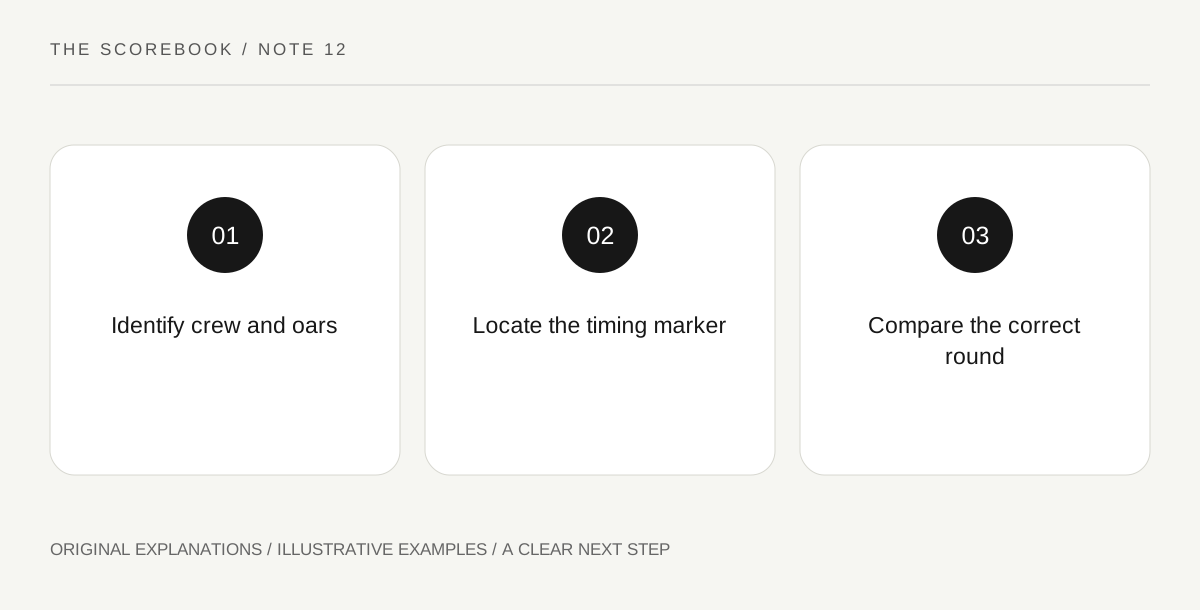
Original explanatory diagram. Read the full method and limitations below.
Count rowers and oars separately
In sculling, each rower uses two oars; in sweep rowing, each rower uses one. A double and a pair both have two rowers, but their oar arrangements differ. The same distinction separates a quadruple scull from a sweep four. Copy the full boat-class label rather than shortening every two-person crew to “pair.” This gives you a reliable vocabulary for the race you are actually watching. It also prevents a comparison of times from silently combining different boat classes. An event’s abbreviation key can help decode compact boat-class labels.
Attach a split to its marker
Classical rowing commonly uses a 2000m course. A split at 500m describes one stage of that race, not a finishing time. Make columns for the marker, the leader and the displayed gap to a selected crew. If the gap changes between two markers, you can describe that selected crew gaining or losing relative time. Keep seconds and physical boat lengths distinct: a camera impression of half a length is not a precise timing measurement. Use the official split for numerical statements.
Watch rhythm without confusing it with speed
The visible rate of strokes is not the boat’s speed by itself. For a viewing exercise, compare a short sequence near the start with one later in the race and describe the rhythm and how the boats move relative to each other. Avoid concluding that the crew with the quickest-looking hands must be fastest. You can observe a change of rate and a change in the displayed gap as separate facts. Whether one caused the other requires more information than a brief broadcast view usually supplies.
Keep rounds and finals in their own lanes
A programme includes different stages, and not every heat awards the same outcome. Write the round and the announced advancement conditions before interpreting a finishing position. A race won in a heat and a medal won in the final are distinct achievements. The event’s progression system supplies the relationship between them; do not import an older event’s repechage assumptions. Your note should preserve the crew, class and round together, so a later result can be compared with the correct earlier performance rather than with an unrelated lane number.
An invented split comparison
Imagine a double sculls race where crew B is 1.6 seconds behind A at 500m and 0.9 seconds behind at 1000m. B has reduced that relative gap by 0.7 seconds over the intervening section. That does not mean B is 0.7 seconds ahead, nor does it provide B’s total race time. Record both gaps beside their distance markers. If B appears farther behind in an angled camera shot, retain the official timing as your numerical reference and describe the picture only as a visual impression.
Practical checks
Optional checkboxes save only in this browser.
Questions that come up
Are a pair and a double the same boat class?
No. Both have two rowers, but a pair is a sweep boat with one oar per rower, while a double scull uses two per rower. The distinction belongs in any comparison of results.
Does the highest stroke rate identify the leader?
Not by itself. Stroke rate is a movement frequency, while the result concerns the boat’s progress. Compare the official position and timing information, and keep your observations of rhythm as a separate description.
References and scope
These sources support the factual background. Examples and exercises are original illustrative teaching material. References do not imply endorsement.
- World Rowing: Scull and sweep — Sculling uses two oars per rower; sweep uses one.
- World Rowing: Rowing 101, August 2026 — Classical 2000m race, boat terminology and the progression of a rowing race.