Field hockey: follow the ball into the scoring circle
A long shot that reaches the net is not enough information to establish a field-hockey goal. In outdoor eleven-a-side hockey, the attacker’s play inside the circle is central. Following the ball’s path through that area makes deflections, shots and apparently surprising non-goals easier to understand.
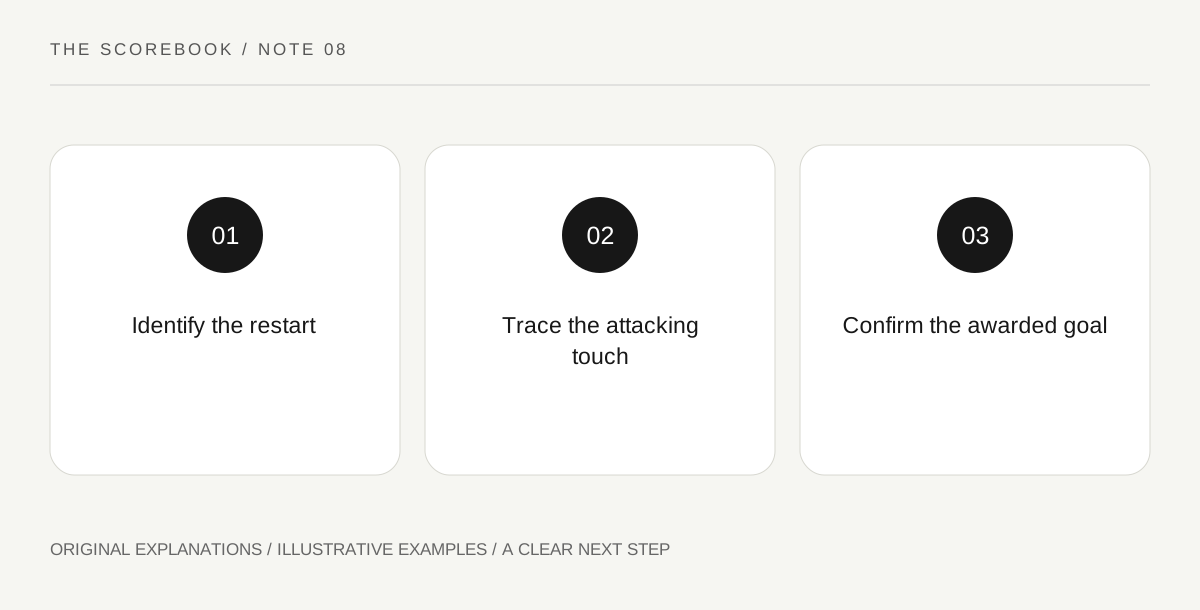
Original explanatory diagram. Read the full method and limitations below.
Use the correct version of hockey
Outdoor eleven-a-side hockey has its own rules. Do not transfer a scoring assumption from indoor hockey, Hockey 5s or ice hockey. The FIH 2026 outdoor rule requires the ball to be played inside the circle by an attacker and then not leave the circle before crossing the goal line beneath the crossbar. Defenders can also touch the ball during that sequence. Checked on 20 October 2026, the FIH lists the 2027 outdoor edition for international implementation on 1 November 2026; national dates can differ. The current event documents remain the reference for a specific match.
Watch the last attacking contact
When the ball is sent toward goal from outside the circle, look for an attacker’s contact inside. Instead of staring only at the net, trace the pass into the crowded area. A high camera angle might show the overall path but hide a fine touch; a close replay might reveal the touch while concealing whether the ball left the circle earlier. Record those as different pieces of evidence. You are trying to reconstruct a sequence rather than guessing from the crowd’s immediate celebration.
Separate an awarded corner from open play
A penalty corner has an organized restart and creates its own set of conditions. Mark the restart in your note so that you do not evaluate the sequence as an uninterrupted ordinary attack. This guide does not try to condense every corner restriction into a slogan. For a newcomer, the useful first step is recognizing the type of play, where the ball travels and which attacker contacts it. Then use the relevant rule section for a specific technical question. Context makes a detailed explanation easier to follow.
Describe an attack with three locations
Draw a small circle and a goal, then label where the ball entered, where the final attacking touch occurred and where it crossed or left the area. Use an arrow for each visible segment. This simple map helps distinguish a pass into the circle followed by a deflection from a ball that travels through untouched. If the crucial contact is hidden behind a player, put a question mark at that point. A diagram should preserve a missing observation, not convert it into a made-up touch.
An invented deflection comparison
In sequence A, a pass starts outside the circle and an attacker clearly redirects it inside before it reaches the net without leaving the circle. In sequence B, the camera shows the same initial pass and a net movement, but the potential attacking contact is obscured. Your map can explain A’s visible scoring path. For B, write “inside contact unconfirmed from this angle” and wait for the award or review. The two clips may look equally exciting, yet your evidence for describing them is different.
Practical checks
Optional checkboxes save only in this browser.
Questions that come up
Can a defender touch the ball before a goal?
Yes, a defender’s involvement does not by itself erase the required attacking play inside the circle. The full sequence and other applicable rules matter. Follow the award rather than reducing the decision to the last player who touched it.
Does every shot from outside the circle count?
No. The circle-scoring requirement is why the attacking contact and subsequent path matter. If a camera angle cannot show the key touch, it is reasonable to wait for the official explanation instead of deciding from the net movement alone.
References and scope
These sources support the factual background. Examples and exercises are original illustrative teaching material. References do not imply endorsement.
- FIH Rules of Hockey 2026 — Outdoor eleven-a-side circle scoring and match provisions.
- FIH current rules and implementation dates — The 2027 outdoor rules take effect internationally on 1 November 2026; national implementation may vary.