Squash lets and strokes: understand why a rally can stop
Squash players share a court, so a rally sometimes stops because access to the ball or a safe swing is in question. A let and a stroke have different scoring consequences. Read the referee’s decision before interpreting the scoreboard, and avoid treating every interrupted rally as identical.
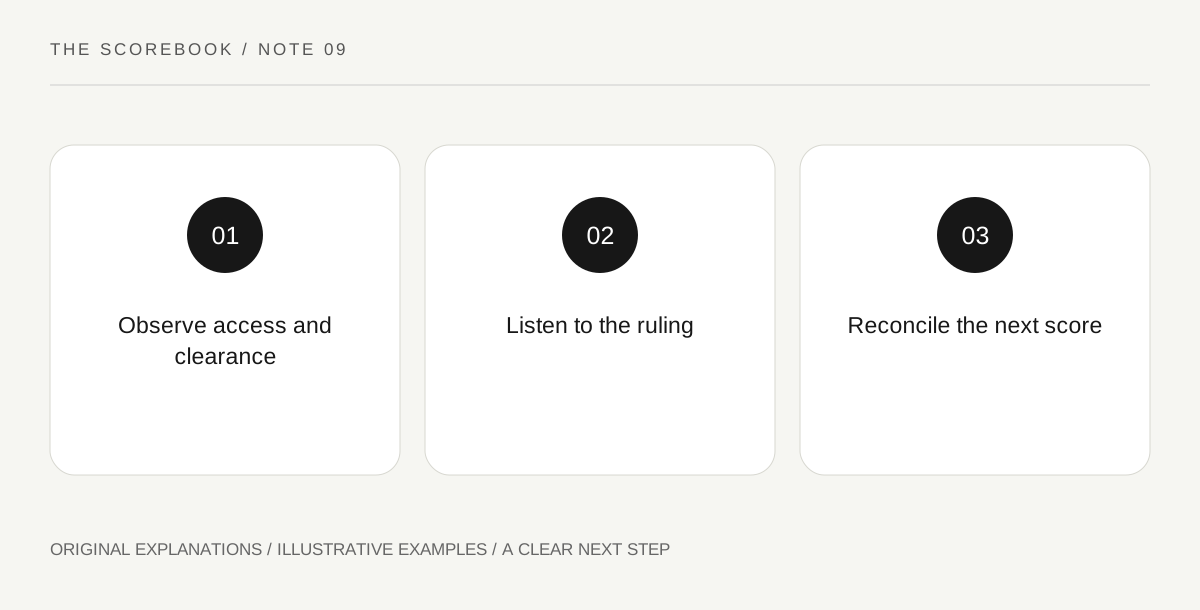
Original explanatory diagram. Read the full method and limitations below.
Begin with the awarded outcome
Under standard singles scoring, a rally winner gains a point and serves the next rally. Games normally go to 11 with a two-point margin. Interference decisions can produce a let, a stroke or no let. A let generally replays the rally; a stroke awards the rally to the player entitled to it; a no-let decision does not supply that replay. This is a starting vocabulary rather than a complete decision tree. The World Squash rules set out the circumstances, including access, clearance, reasonable effort and the opportunity to strike safely.
Follow the players as well as the ball
For a single exchange, watch the striker move toward the ball and the opponent move away after the previous shot. The visible question is not only whether the ball could physically be reached. Note whether the route is clear and whether the player has space to prepare the swing. A side-wall camera can hide the separation between bodies. Record where you lose sight of the players instead of deciding that a narrow-looking gap proves deliberate obstruction. The shared space is the feature your viewing note should capture.
Reconcile the call with the score
Make one line for the interrupted rally, then write the announced decision and the next displayed score. If a review changes the decision, correct that line. You should not add a point for the original call and a second point for the corrected one. Where the score stays unchanged and the rally repeats, mark a replay rather than a missing point. This small accounting habit is especially helpful near deuce, when a single award can create game ball or return the players to a level score.
Ask a precise replay question
Instead of asking whether the decision was “fair” in the abstract, choose one observable issue: where the opponent was after the shot, whether the ball’s path was visible, or where the striker stopped. Replay the whole movement before isolating a frame. A freeze-frame of two players close together cannot show all the effort made to clear or reach the ball. Your analysis can remain useful even when you cannot reproduce the referee’s full view. Keep a distinction between describing the evidence and claiming an officiating qualification.
An invented score correction
Suppose a game is 9–9 when a rally stops. A let would leave the score at 9–9 and replay that point. A stroke awarded to A would make it 10–9 to A, while a different awarded outcome could change the other side’s score. If the decision is reviewed, write the final call once and check the board before the next serve. The example shows why the same visible stoppage cannot be assigned a score in advance. The consequence comes from the ruling, not from the mere fact that both players stopped moving.
Practical checks
Optional checkboxes save only in this browser.
Questions that come up
Does every collision mean a let?
No. The rules consider the particular interference and each player’s actions. A let is one possible decision, not a universal response whenever players are close. The official ruling controls the rally’s scoring consequence.
Can a better camera angle change my impression?
Yes. Access, movement and the swing space can look different from another viewpoint. Record what your angle shows and what it hides. A careful description is more useful than certainty based on an obstructed replay.
References and scope
These sources support the factual background. Examples and exercises are original illustrative teaching material. References do not imply endorsement.
- World Squash Officiating: Rules of squash, September 2025 — Rally scoring to eleven with a two-point margin, interference and let/stroke decisions.